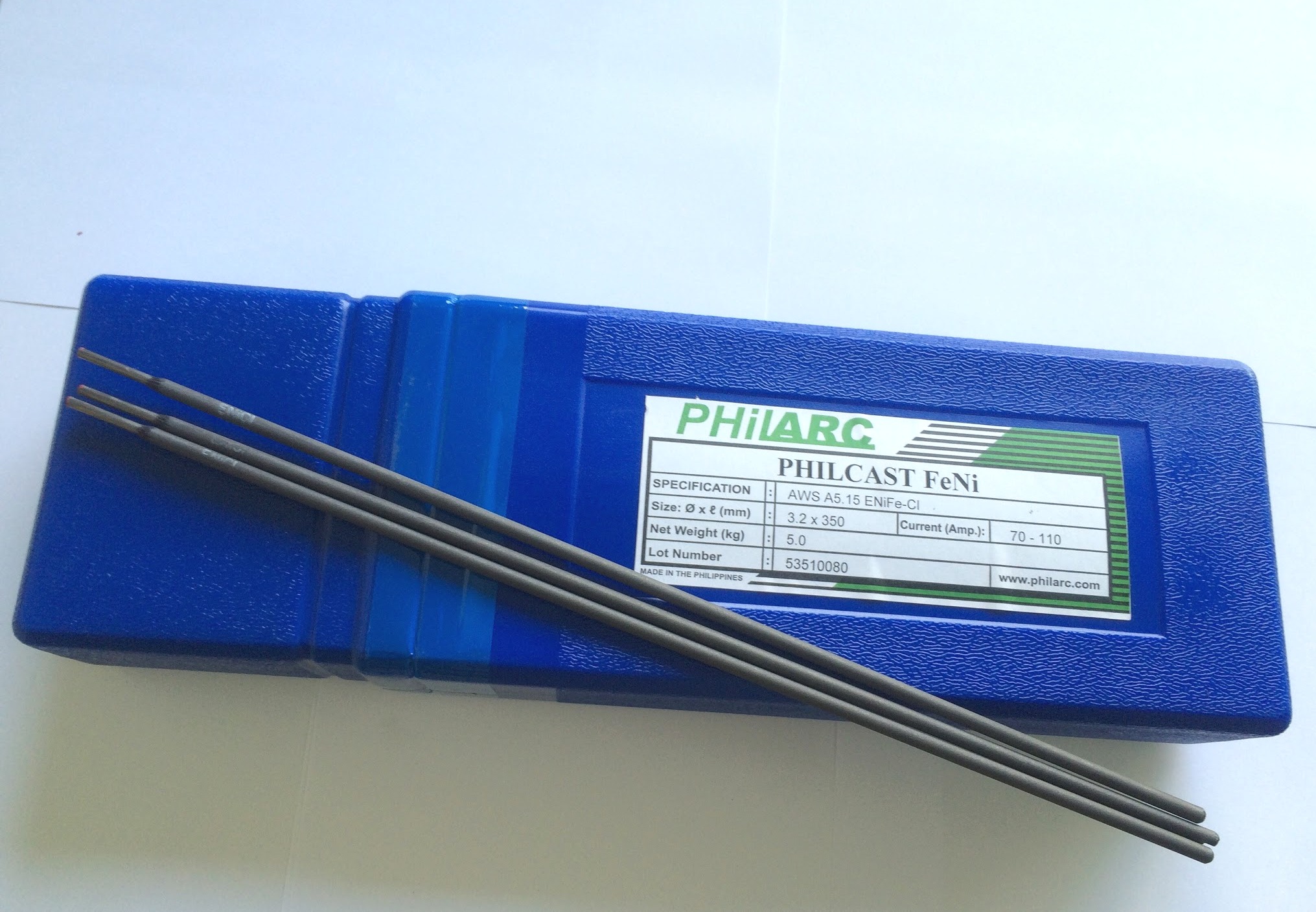
SPECIFICATIONS:
JIS DFC NiFe,
AWS A5.15/SFA 5.15 : ENiFe-Cl
DIN 8573 : ENiFe-G2
I. APPLICATIONS:
For repair and fabrication of cast iron housings, blocks, machinery, parts, frames, casting defects, casting flaws,
machine cuts, machining errors, repair of cracks, rebuilding worn or damaged areas and joining thick section
castings and cast irons to steel. Suitable for the welding of Meehanite cast iron, some alloy cast irons and the
austenite “Ni-Resist” types.
II. DESCRIPTION:
An iron-nickel alloy Shielded Metal Arc Welding electrode for high strength joints on cast iron. Also for the
fabrication and repair of a wide range of cast iron components and for the joining of cast iron to steel. It is
used primarily for welding nodular graphite or shperoidal graphite (SG) cast irons and is also suitable for
welding the austenitic Ni-Resist irons and alloy cast irons.
PHILCAST Fe-Ni weld deposits provide good levels of strength, are very resistant to cracking and the weld
metal is fully machinable. PHILCAST Fe-Ni is specially manufactured to avoid electrode overheating.
PHILCAST Fe-Ni is a very easy electrode to control due to the soft smooth arc characteristics which
produce even weld beads of good contour. Suitable for use with both AC (minimum OCV of 50V) and
DC+.
III. NOTES ON USAGE:
It is essential that all traces of paint, grease, oil, rust and oxides are removed prior to welding and that
particular attention is paid to castings with sand inclusions or which have been impregnated with oil. Use
PHILARC PA-GR are cutting/gouging electrodes for the removal of defects and the preparation of cracked
sections. Joints and cracks should also be grooved.
Generally, small section castings can be welded without preheat, however it is important that the base
metal interpass temperature does not rise above the “hand-hot” level. Deposit in short intermittent beads
about 25mm to 50mm with frequent interruptions to allow cooling to take place. Fill crater at end of each
weld bead. Remove all traces of slag remnants before applying the next bead. Deposit without weaving
and hammer pein each weld bead, whilst still hot, to reduce both local stresses and the risk of weld metal
cracking. Large castings should be heated slowly and uniformly to a temperature in the range of 100-
300ºC (depending upon possible. After welding, the workpiece should be cooled slowly at an even rate,
cover with mineral blankets or immerse in warm dry sand, lime or vermiculite.
IV. TYPICAL CHEMICAL COMPOSITION OF WELD METAL (%):
C Mn Si Fe Ni
1.18 0.49 0.7 Bal 56.8
WELDING PRODUCTS PRODUCT DATA SHEET
V. TYPICAL MECHANICAL PROPERTIES OF WELD METAL:
Tensile Strength
N/mm2 (ksi)
Elongation
%
Hardness
HV (HRC)
480 (70) 18 170-190 (85-90 HRB)
VI. WELDING POSITIONS: ALL POSITION – EXCEPT VERTICAL DOWN
VII. SIZES AVAILABLE AND RECOMMENDED CURRENTS (AC or DC + ):
Size
(mm)
Dia. 2.5 3.2 4.0 5.0
Length 300 350 350 350
Current Range Amp 50-80 70~110 100~140 130~170